Ag Newsletter - 14 August 2026
With the new financial year underway, the agricultural employment market is seeing a distinct shift in momentum. In our August Market Update, Drover Ag Managing Director John Boote unpacks the recent surge in recruitment activity, why top candidates are actively on the move, and how forward-thinking farmers are looking past external market noise to build stronger, better-structured teams. Read the latest Ag Employment Market Update Now.
 John Boote
Broadacre Cropping & Agronomy:
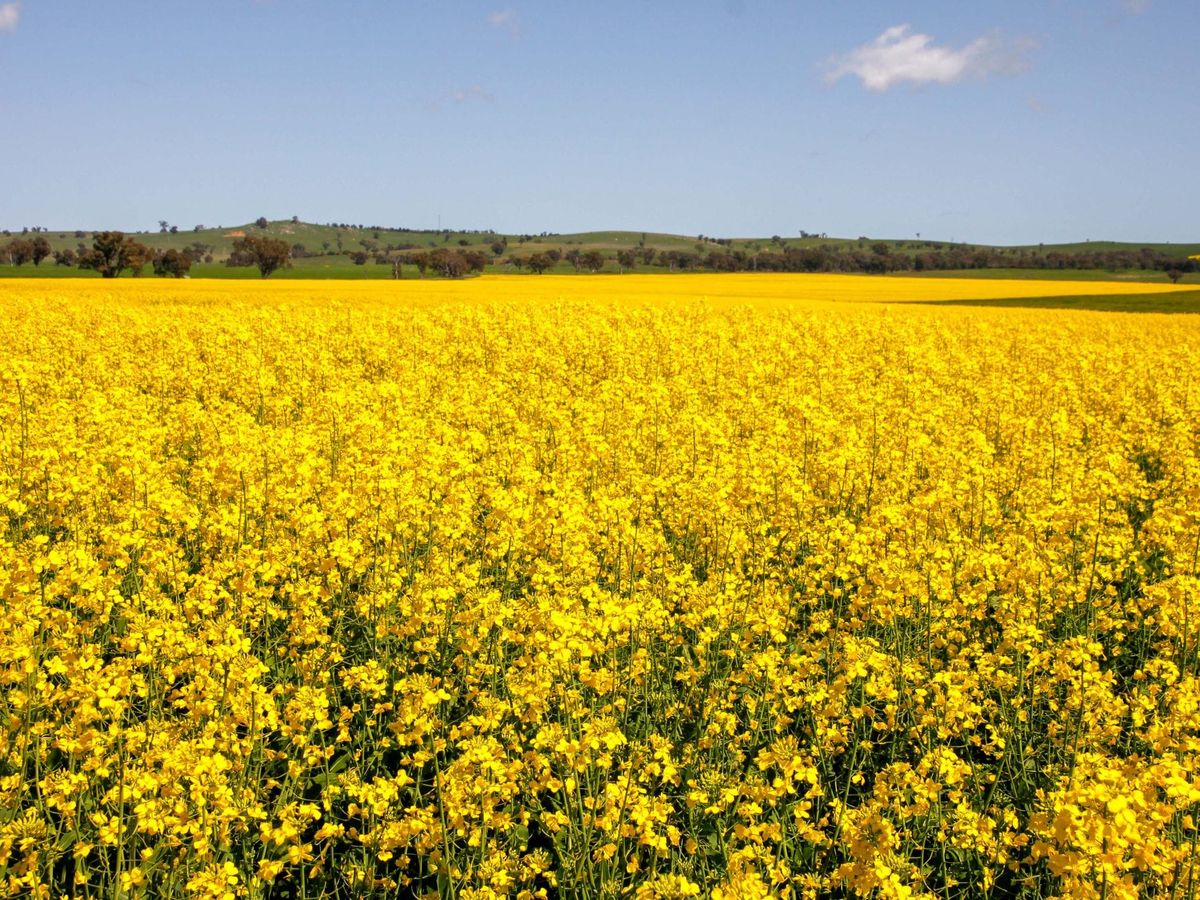
DAS Report Identifies Record Back-to-Back Canola Plantings - Digital Agriculture Services (DAS) released new satellite analysis in its Canola on Canola: The 2026 Season report, revealing that Australian broadacre growers have planted nearly 92,000 hectares of canola directly into last season's canola stubble. This represents a record 2.1% of the national canola area—surpassing the previous 2022 peak.
The report notes that while high forward prices driven by global oilseed markets have incentivised canola area, agronomic monitoring indicates elevated blackleg pressure across southern cropping belts. Industry agronomists advise growers navigating successive in-crop rain events to monitor paddocks closely and time fungicide applications carefully. Source: Digital Agriculture Services / Grain Central
Canola Genetics Research Aims to Develop Frost-Tolerant Varieties - The Western Australian Government and the Grains Research and Development Corporation (GRDC) announced a national collaborative research project titled Reducing the Frost Sensitivity of Canola in Australia.
Researchers are screening extensive domestic and international canola germplasm to identify specific genetic traits that enable viable pod set during spring frost events. Because frost during flowering and pod fill remains a primary financial risk for early-sown broadacre oilseeds, developing frost-resilient lines will assist southern and western grain growers in protecting yield stability. Source: Western Australian Government / GRDC
Livestock Markets Summary:
A wet week across southern Australia tightened livestock yardings, driving price lifts for light and Merino lambs while creating sharp north-south price premiums for cattle. Processing activity rebounded strongly across all categories as abattoirs resumed operations following maintenance.
Cattle Markets (Tight Supply, Mixed Prices):
- Yardings: Dropped 24% week-on-week (WoW) to 51,057 head.
- Prices: Processor and export lines eased, but restocker demand held up. The Restocker Yearling Steer Indicator rose 1% to 471¢/kg lwt (averaging 508¢ in NSW/southern states vs. 471¢ in QLD).
- Regional Premiums: The Feeder Steer Indicator fell 4% overall to 484¢/kg lwt, but NSW commanded a major premium (averaging 528¢/kg) compared to Queensland (443¢/kg).
Sheep & Lamb Markets (Rain Restricts Supply):
- Yardings: Lamb yardings fell 10% (121,036 head) and sheep yardings plummeted 40% (36,383 head), heavily impacted by rain interruptions at major hubs like Wagga (down 11,000 head).
- Prices: Reduced numbers pushed most indicators higher—Light Lambs lifted 4% to 1,087¢/kg cwt, and Merino Lambs rose 4% to 1,082¢/kg cwt. Conversely, the Restocker Lamb Indicator dropped 3%, while Mutton held firm at 819¢/kg cwt (+0.2%).
Slaughter Rebound:
- Cattle Slaughter: Lifted 4.4% WoW to 148,928 head, led by a 16% processing jump in NSW post-maintenance.
- Lamb & Mutton Slaughter: Lamb processing rose 5% (to 367,655 head) and mutton jumped 12% (to 97,619 head), driven primarily by Western Australia reopening plants after scheduled downtime (+65% for lambs, +27% for sheep).
Source:Meat & Livestock Australia (MLA)
Weather & Climate:
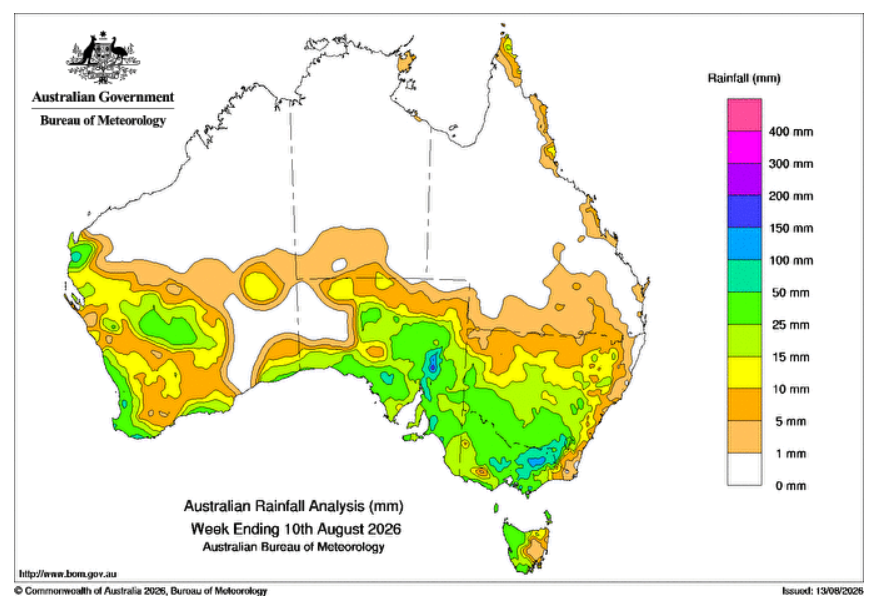
Strong Cold Front Delivers 15–50mm Falls Across Southern Grain Belts - The Bureau of Meteorology’s (BOM) weekly rainfall update confirms that a series of low-pressure troughs and a strong cold front have moved across southern Australia. The system delivered widespread rainfall totals of 15 to 50 mm across southern Western Australia, large parts of South Australia, Victoria, western Tasmania, and most of New South Wales.
Heavy localised falls exceeding 50 to 100 mm were recorded across central and north-eastern Victoria, extending into south-eastern NSW, with the Flinders Ranges in SA also recording totals over 100 mm. The highest weekly total was recorded at Myrhee (Hancocks) in north-eastern Victoria at 178.4 mm (including 159 mm falling within a 24-hour window). The widespread moisture boost provides a critical top-up for winter broadacre crops as they transition toward peak spring growth. Source: Bureau of Meteorology (BOM) Rainfall Update
Seasonal Outlook - Rain provided welcome surface moisture across WA, SA, NSW, and Victoria. However, subsoil moisture remains below average across northern NSW, large parts of Queensland, and south-western WA.
Water storage in the Murray-Darling Basin currently sits at 59% capacity—down 10% from the same time last year. Looking ahead, the long-range spring climate outlook indicates a 50–70% chance of below-average rainfall for parts of south-eastern Australia, while western and northern regions are more likely to receive average to above-average falls. Sources: ABARES / BOM
Transport & Logistics:
WA Driver training initiative - The WA state Government announced the opening of a brand-new, bespoke truck training facility in Hazelmere, WA. The facility is designed to train up to 170 students a year in Heavy Vehicle Driving Operations, offering a "one-stop-shop" where students can gain multiple licenses (including Heavy Rigid and forklift) and safety competencies. Training is delivered free of charge (saving students up to $356 per enrollment) through North Metropolitan TAFE in partnership with Keen Bros, aiming to address the national shortage of 28,000 truck drivers. Source: WA Govertment Media Release
Dairy Update:
Recent updates show full-season dairy export volumes fell 4.3% YoY despite a June surge, alongside a rising AUD that reached a seven-week high. On-farm, a 27% YoY drop in July cow culling marks the fourth consecutive month of herd retention. In retail, Woolworths has begun phasing out its 'Farmers' Own' milk brand, which will exit all states by mid-2027 as supplier contracts expire. Source: Milk Value Portal
Worker Health & Safety:
Victorian Dairy Sector Expands Subsidised Q Fever Program - Dairy Australia and GippsDairy, in partnership with WorkSafe Victoria, have expanded their dedicated Rethinking Q Fever program across Victoria's dairy regions. The project provides farm owners, sharefarmers, and agricultural employees over 15 years of age with access to subsidised Q fever screening and vaccinations until May 2027. Because Q fever represents a major occupational risk for workers handling livestock and unpasteurized milk, the initiative aims to reduce health hazards for regional farm teams while helping employers meet Work Health and Safety (WHS) compliance standards. Source: Dairy Australia